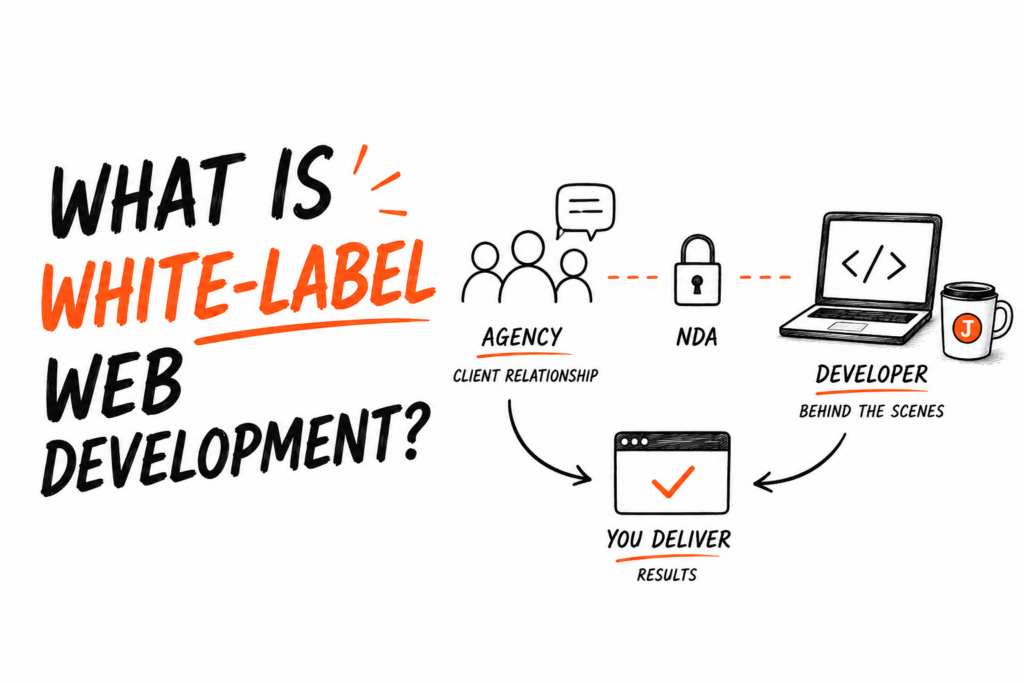
Your agency has the client relationship. You've understood the brief, shaped the design and agreed what needs to be delivered.
Now you need someone to build it.
White-label development lets you bring in that support while keeping the project under your agency's name. The developer works behind the scenes, with responsibilities and communication agreed before the work begins.
That last part matters. “White-label” describes the arrangement. It doesn't automatically answer every practical question about working together.
How the relationship sits
The agency keeps the client relationship. Development support sits behind the scenes.
-
Brief
Agency
Understands the client, shapes the design and agrees what needs delivering.
-
Build
Josh / developer
Works behind the scenes, with communication agreed before the work begins.
-
Review
Back to the agency
The agency reviews, gathers feedback and keeps the client relationship.
-
Handover
Agency to client
Training, files and the route for later questions stay with the agency.
Brief
We start with what you've promised
Before I can sensibly quote or schedule the work, I need to understand the project you've sold.
That includes the approved design if there is one, the functionality and the expected handover. I also need to know which parts are settled and which are still moving.
If you've promised the client a particular editing experience or integration, flag it early. A sentence in your proposal can represent a significant part of the development work.
You don't need to rewrite the whole brief for me. I'd rather see the relevant material and ask useful questions than make you produce another document saying the same thing.
Working arrangement
We agree where I fit
Some agencies want a developer who works entirely through their project manager. Others need occasional technical input on a call, presented in a way that fits the agency relationship.
Either can be workable when it's agreed.
The important thing is knowing who speaks to whom and who approves changes. I shouldn't be guessing whether to answer a client directly, and you shouldn't discover a technical conversation has happened without you.
If I need an answer from the client, we can route the question through you or use whatever process we've agreed. The aim is to help the work move without making you manage unnecessary noise.
Confidentiality belongs in the setup
If you require an NDA, send it through before sharing confidential project material so the terms can be reviewed and agreed.
Portfolio use should be explicit too. A project delivered for your client isn't automatically something I can publish under my own name. Credits, screenshots and case studies need to follow the permission we've agreed.
Access should suit the job. I may need the development environment and relevant assets; that doesn't mean I need unrestricted access to everything your agency uses.
These are ordinary working arrangements to settle at the start. They help make the relationship comfortable for both sides.
Review
The preview comes back to you
During development, I'd normally give the agency a place to review the work and gather feedback before it goes to the client, unless we've agreed another route.
You know the wider project and the decisions that led to the design. Your review can catch things that wouldn't be obvious from the file alone.
It helps to separate a build issue from a new request. If something doesn't match what was agreed, it needs fixing. If the client now wants an additional feature, we need to assess what that changes.
That protects your schedule as well as mine. You can explain the impact before making a new promise.
Feedback needs a clear route back
A single collected set of comments usually works better than scattered messages from several people.
Specific feedback helps too. “The heading should match the approved mobile layout” is something I can act on. “The client isn't sure” probably needs another conversation before development changes will help.
If there is a point where I think a design decision will cause a practical problem, I'll raise it. I'd rather explain the issue and suggest a way through than quietly substitute something you didn't approve.
The agency keeps control of the client relationship. The developer still needs room to contribute useful judgement.
Handover
Handover is part of the deliverable
Decide who is receiving the website and what they need to manage it.
You might want to handle the client training yourself. You might need short instructions you can pass on, or a walkthrough for your internal team before you present it.
The project should also be clear about files, accounts and any third-party licences. Agree who owns or controls each part and who pays for renewals. Don't leave those questions until launch day.
After launch, the route for reporting faults or requesting new work needs to be understood. Your client should get a consistent experience, and you should know how to bring development questions back to me.
You don't need to make it complicated
A small project doesn't need a huge process. It needs enough clarity that neither side is filling the gaps with assumptions.
Once we've worked together, the next project can feel more familiar. I understand how your team reviews work, and you know what I need to get started.
That's the relationship I'm interested in: useful development support you can bring into the work when you need it.
Agree this before starting
Ordinary working arrangements that keep the relationship comfortable.
- Communication: who speaks to whom, and who approves changes
- Portfolio permission: credits, screenshots and case studies
- Post-launch responsibility: faults, new requests and renewals