You open your website and wait for the main image. Then the text moves. Then a pop-up appears, just as you try to press something.
You don't need a speed score to know that feels poor.
A test can help explain it, though. The useful next step is finding out what is causing the delay, rather than installing a performance plugin and hoping for the best.
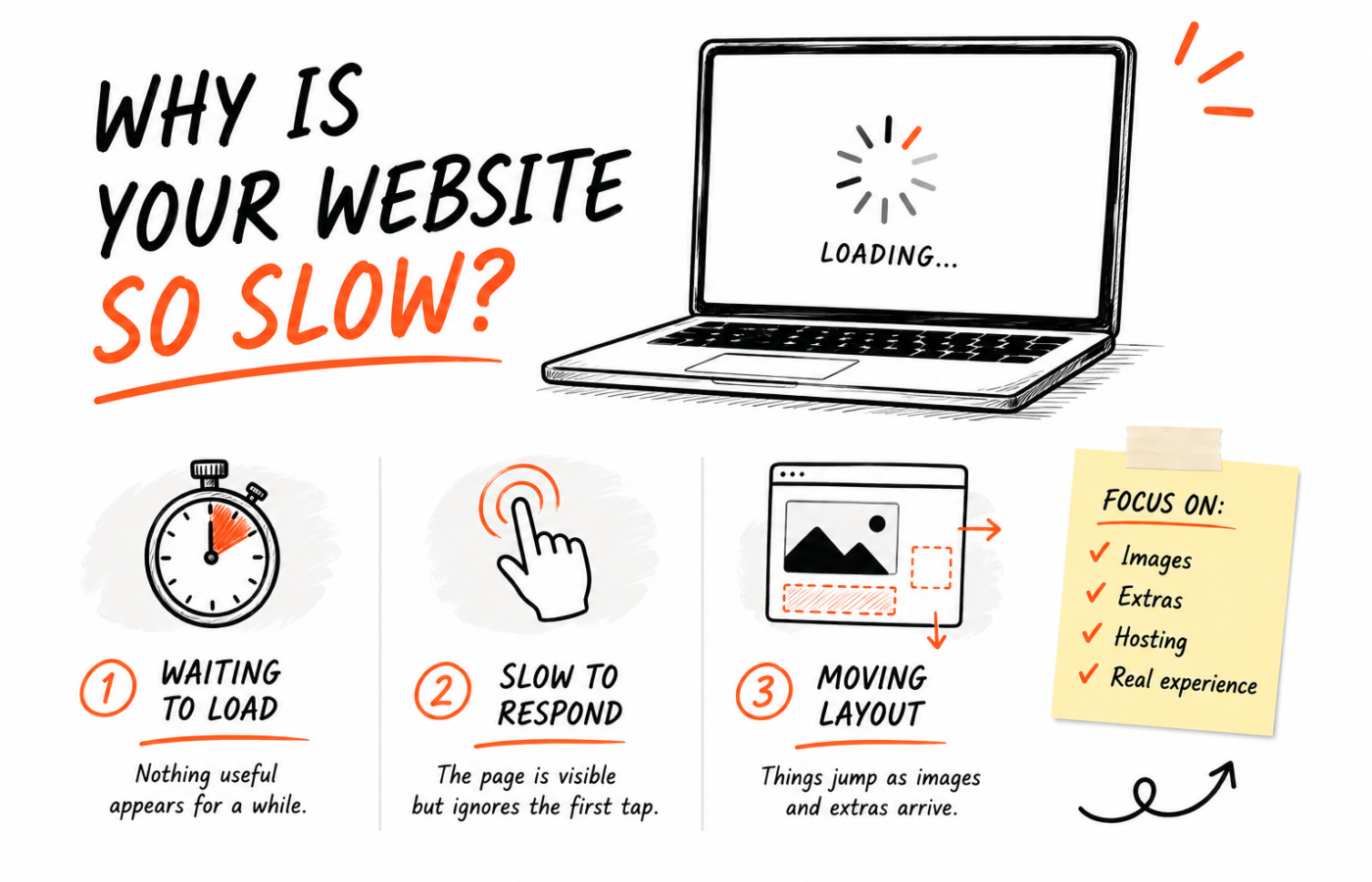
- Waiting to load Nothing useful appears for a while.
- Slow to respond The page is visible but ignores the first tap.
- Moving layout Things jump as images and extras arrive.
Start by describing the slowness
Does nothing appear for a while? Does the page show up quickly but ignore your first tap? Does the layout move around as things arrive?
These are different problems. Google's Web Vitals guidance separates loading, responsiveness and visual stability for that reason.
I'd also ask where you're testing. A page that's familiar to your browser on a fast connection may feel different to someone opening it for the first time on a phone.
Try the pages people actually use, including a service page or product page. The homepage isn't the whole website.
The images may be doing too much
A large photograph displayed in a small card can make someone download far more image data than the layout needs.
Sizing and compression matter. So does serving suitable image sizes for different devices. Google's image performance guide explains these approaches in more detail.
This doesn't mean every image should become small and blurry. A photographer's portfolio needs to show the work properly. The job is to preserve the useful quality without transferring unnecessary data.
I'd check the images actually loaded by the page, rather than assuming the files were optimised because they look small on screen.
Some things are arriving at the wrong time
A gallery near the bottom of a long page doesn't necessarily need all its images immediately. Delaying off-screen images can reduce the initial work, using lazy loading.
But applying that approach indiscriminately can cause another problem. The main image at the top of the page is something the visitor needs now; delaying it can make the page feel slower.
The order matters. Performance work involves deciding what's needed first, not simply turning on every option labelled “optimise”.
The extras add up
A chat widget may be useful. So might an embedded video or a tracking tool. Each addition can also bring scripts and other resources into the page.
Browsers have to download and process that work. The resource loading guidance on web.dev covers how JavaScript and styles can affect rendering and responsiveness.
I'd look at what each extra is doing for the business. Is the chat monitored? Is an old marketing script still loading after the campaign has ended?
That review needs care. Removing something without understanding it can break a useful feature or your reporting. Test changes in a suitable environment and keep a way to reverse them.
Hosting can be part of it
Sometimes the delay begins before the browser has much to display. The server may be taking too long to generate or return the page, which is one of the issues covered in Google's HTML performance guidance.
That doesn't automatically mean buying a more expensive hosting plan will solve everything. The application itself may be doing unnecessary work. Caching may help some pages, while pages with personal or changing information need different handling.
I'd measure the response and understand the setup before recommending a move.
A score is a clue
A performance report is useful for finding problems and checking whether a change helped. It isn't a complete description of how customers experience the website.
Look at available real-user data alongside controlled tests, and pay attention to the tasks that matter. If the product options freeze when someone makes a selection, that deserves attention even if the homepage report looks healthy.
I wouldn't promise a perfect score before seeing the site. I would want a clear explanation of what's slow, a sensible order for fixing it and checks that the improvements haven't broken something else.