You don't need to turn up with a finished brief and a folder organised well enough to win an award.
Some useful information does help, though. It means the first conversation can get past “I need a website” and into what you actually need from it.
If you haven't got all of this yet, that's fine. Treat it as a way to gather your thoughts, not an entry requirement.
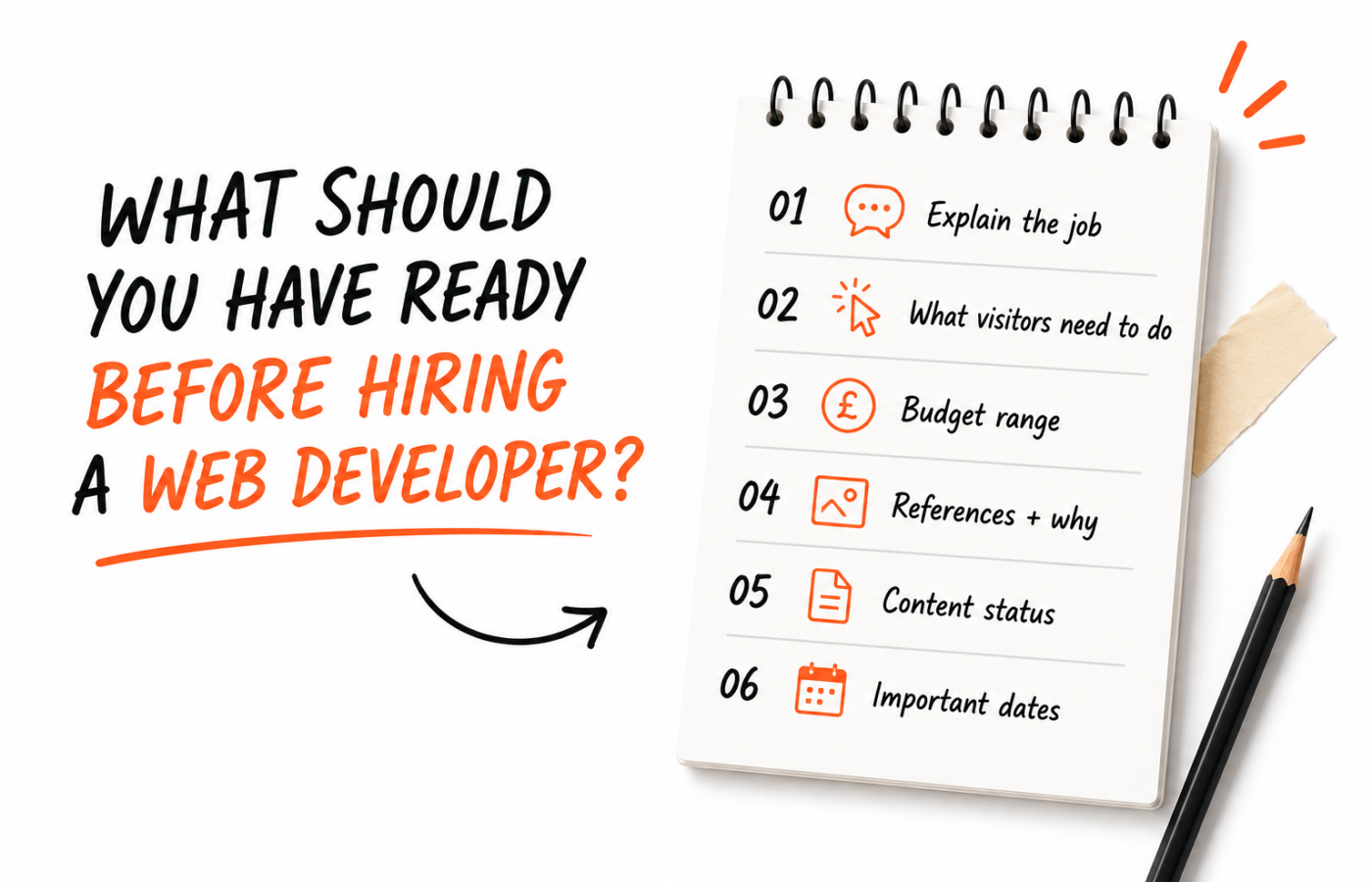
A plain explanation of the job
Start with what the business does and why you're looking for a website now.
Perhaps you're starting something new. Perhaps the old site is difficult to update, or you need a developer to build a design you've already commissioned.
You don't need technical language. “Customers keep asking questions the website should answer” is useful. So is “We want to show our projects properly instead of sending a PDF every time.”
That gives me more to work with than a list of effects you like.
The things visitors need to do
Think about the main action someone should be able to take.
For one business, that's making an enquiry. For another, it's buying a product or finding the right property. There may be several actions, but they probably aren't all equally important.
If the website needs to connect to something you already use, mention it. Even a rough description helps: “Bookings need to reach our existing calendar” is enough to start checking what's involved.
You don't have to know how to make the connection. You do need to tell me it exists.
A realistic budget conversation
Sharing a budget helps establish what we can sensibly plan.
If you don't know what the work should cost, say so. We can talk through what affects it and what could be simplified. But if you have a firm limit, it's better to know before discussing features that won't fit.
Think about ongoing costs too. A build budget and a monthly running budget cover different things. Neither needs to be perfectly calculated before we speak, but both belong in the conversation.
A few references with reasons
Links to websites you like are useful when you explain what you're responding to.
Maybe it's the way they present their work. Maybe the menu is particularly clear. You might like the overall feel but dislike the animation.
That detail matters. Two people can look at the same reference and notice entirely different things.
A couple of considered examples usually tells me more than a long list with no explanation. We're using them to understand your preferences, not to copy someone else's website.
An honest picture of the content
Do you have copy and images ready? Does someone need to write the text? Are there existing pages or products to bring across?
“Mostly ready” can mean everything from a final document to a few notes on someone's phone. Neither is a problem if we know which one it is.
If several people need to approve the content, mention that too. It affects how we plan the work.
For agencies with an existing design, a Figma link and a note about what's approved is a good start. You don't need to spend days tidying the file before asking whether I can help.
Any date that genuinely matters
A launch tied to an event is different from a general preference to finish quickly.
Tell me the date and the reason behind it. If there are things you're happy to add later, that gives us room to plan a useful first version.
It also helps to know when you'll be available to review the work. A tight deadline needs attention from both sides.
You can leave this until later
What you can leave until later
You don't need to choose every plugin or decide how the pages will be coded. You don't need a perfect sitemap before making contact either.
And you shouldn't send passwords in an initial enquiry. We can arrange suitable access when it's needed.
Bring what you know. Be clear about what you don't. That's a perfectly good place to start.
Ready to enquire?
Bring what you know. An incomplete brief is still a good place to start.
- A plain explanation of the job
- The main thing visitors need to do
- A budget range, or an honest “I don’t know yet”
- A couple of references with reasons
- A rough picture of the content
- Any date that genuinely matters