Two people quote for the same website. One price is manageable. The other makes you wonder whether you accidentally asked for a new office as well.
Both mention a homepage, a few service pages and a contact form. So why are the numbers so different?
Sometimes you're comparing different businesses with different overheads. Sometimes one person has misunderstood the job. Quite often, the proposals cover very different amounts of work, even though the page lists look almost identical.
The difficult part is knowing which difference matters to you.
A page count only tells you so much
“Five-page website” sounds like a useful description. It gives everyone a rough sense of size.
But imagine two five-page websites. The first uses an existing theme, with supplied copy dropped into layouts that barely need changing. The second has an original design, a searchable project gallery and a booking system connected to software the business already uses.
They have the same number of pages. They aren't the same job.
Illustrative examples
Five pages
Straightforward brochure site
An existing theme, supplied copy dropped into layouts that barely need changing.
- Homepage, services and contact
- Limited original design work
- A simple contact form
Five pages
Same count, more included
Original design, a searchable project gallery and a booking system connected to software the business already uses.
- Custom page types
- Integrations and search
- More thought in the editor
Even a contact page can be a short form or something more involved. Perhaps enquiries need to go to different people depending on the service selected. Perhaps visitors need to upload a document. Someone needs to decide what happens when that upload fails.
When I look at a project, I need to understand what the pages actually do. Counting them comes later.
Someone has to work out what belongs on those pages
You might already have a clear plan and finished designs. That's useful. You might also have an existing website that no longer describes the business properly, plus a folder of images and a few ideas.
Those are different starting points.
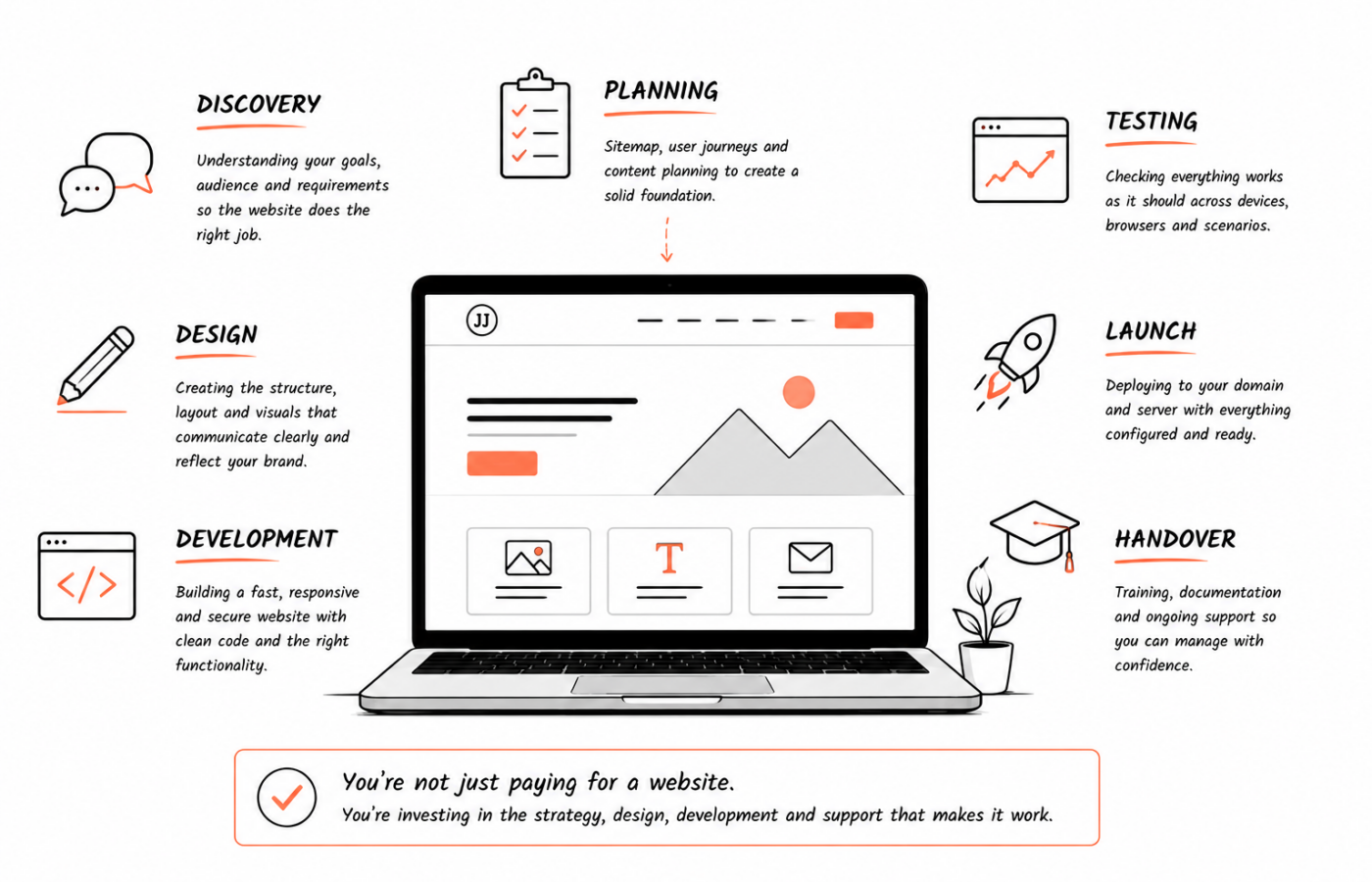
Working out the content and structure is part of the work, whether it's included in the developer's quote, handled by a designer or done by you. It doesn't disappear because nobody has given it a line in the proposal.
Take a business offering several related services. Should each service have its own page? What would a visitor need to know before enquiring? Is the distinction between the services obvious to anyone outside the company?
You don't need weeks of workshops to answer every question. You do need enough thought to avoid building a polished version of the wrong thing.
If a quote assumes you've already made these decisions, it may be lower for a perfectly sensible reason. Just check that the assumption is right.
Design can mean quite different things
One proposal might include choosing colours and adapting a ready-made layout. Another might include designing the main page types from scratch and working through revisions with you before development begins.
Neither approach is automatically wrong.
A business that needs a straightforward first website may get exactly what it needs from a carefully chosen template. A studio with a distinctive visual identity may want far more control over the finished result.
The useful question is what “design included” means in that particular quote.
Will you see layouts before the site is built? How much can you change? Does the price cover a mobile design, or will the developer make those decisions during the build? If you've already paid a designer, how closely is the developer expected to follow their work?
Get that clear early. It helps everyone talk about the same outcome.
The editing experience takes work too
The part visitors see isn't the whole website.
You'll also have somewhere to manage your content. That might be an editor you use every week, or something you open twice a year and hope you still remember.
Either way, it needs to make sense.
For a WordPress project, I might build content blocks around the sections you'll actually use. A project block could have clearly labelled fields for its image, summary and link, with the visual layout already handled. WordPress supports this kind of block-based editing through its block editor.
That involves more thought than giving you a blank page and access to every possible setting. It can also save you from needing help with small updates once the website is live.
Ask to see how you'll add a new project or change a service. A quick demonstration tells you more than “fully editable” ever will.
Testing is easy to miss in a quote
You can open a homepage, decide it looks good and still miss quite a lot.
A form might display a success message while its notification never reaches the right inbox. A menu might work with a mouse and become awkward on a phone. A layout might cope with the sample content but break when you add a longer title.
Testing means working through those situations, then fixing what turns up.
The amount of testing should match the website. A small brochure site doesn't need the same process as a complicated online shop. But “we'll have a quick look before launch” leaves plenty of room for misunderstandings.
I'd want the important journeys checked, including the parts that happen after a visitor presses a button. If the point of the website is to generate enquiries, the enquiry needs to arrive somewhere useful.
Existing websites bring their own jobs
Replacing a website can involve work that a brand-new business doesn't have.
You may have useful articles to move, product data to clean up or existing page addresses that people already visit. Someone has to decide what stays and what happens to the old URLs.
There's also the launch itself. Moving a site onto hosting and checking it on the live domain is different from showing you a working preview.
Be particularly clear about email if you're changing hosting or domain settings. The website and your business email may rely on some of the same domain configuration, even when different companies provide them. The person handling launch needs to know what's already there.
None of this is especially glamorous. You probably won't see it in a portfolio. It still needs doing.
A lower price can move work onto you
There is nothing wrong with keeping costs down by doing part of the job yourself.
You could supply finished copy, prepare the product information or choose a simpler first version. Those can be sensible decisions, particularly when the business is still finding its feet.
The problem is discovering your share of the work halfway through.
If a quote assumes you'll upload eighty products, make sure you have the time and know what's involved. If you're responsible for the copy, agree when it needs to be ready and whether anyone is helping you shape it.
Cheap becomes frustrating when it means “less included than you expected”. Expensive becomes frustrating when you're paying for things you don't need. A clear scope helps with both.
Cheap becomes frustrating when it means ‘less included than you expected’.
Ask what happens after launch
Does the price include a handover? Is there a period for reporting faults? Who handles future updates, and what counts as a new request?
Ongoing costs also deserve a proper answer. Hosting and domain renewal are separate from the initial build unless the proposal says otherwise. There may be paid software or platform subscriptions too.
You don't need a complicated forecast. You do need to know which bills will arrive and who is responsible for them.
If support is available, ask what it covers. “Maintenance” is a broad word. It could mean software updates, a set amount of editing time or something else entirely.
Compare the work, then compare the price
I wouldn't choose a developer purely because they were the cheapest. I wouldn't assume the highest quote was the best either.
I'd look for someone who understands the job and can explain what they're including without making it sound mysterious.
Put the proposals beside each other. Look at what you'll receive, what you need to supply and what remains your responsibility afterwards. Then decide which approach suits the business and the budget you actually have.
A website quote should help you make a decision. You shouldn't need another professional to translate it.
Before you compare quotes
Use this as a prompt, not a mandatory form.
- Scope: what the pages actually need to do
- Your responsibilities: copy, assets, decisions and access
- Launch: hosting, domains, redirects and email
- Ongoing costs: hosting, software and who handles updates